
Eclipse Ditto open source Support Subscription: manage your digital twins with full data sovereignty
You want to manage your IoT devices, monitor and control them remotely, and leverage the capabilities of digital representation for better insights and decision-making? Then Eclipse Ditto is your ideal solution.
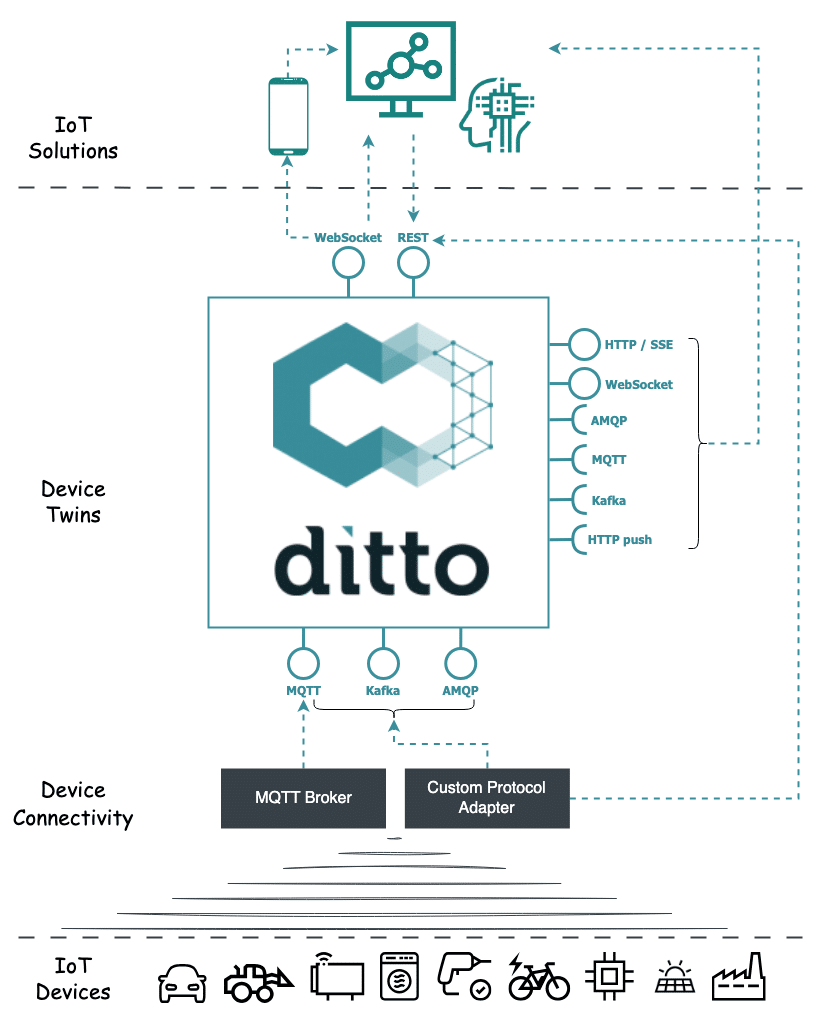
Eclipse Ditto is a technology implementing the digital twin pattern in the IoT. A digital twin is a virtual, cloud-based representation of its real-world counterpart — real-world “Things” such as devices, sensors, smart heating systems, connected cars, smart grids, or EV charging stations. It is a JSON object in Ditto that stores the device’s latest state, enabling interaction even when the physical device is offline.
The technology mirrors potentially millions of digital twins in the digital world with their physical counterparts. This simplifies developing IoT solutions for software developers, as they do not need to know how or where exactly the physical things are connected.
Your advantages at a glance
- Full data sovereignty — runs entirely on your own infrastructure; no data leaves your perimeter
- Proven solution for creating, managing, and interacting with digital twins at scale
- Protocol agnostic — works with MQTT, HTTP, AMQP, Kafka, and other messaging protocols
- Extensibility — developers can extend and customize functionality to meet specific use cases
- Open source and community support — Eclipse Foundation governance, active community, and continuous improvement
- Scalability — designed to scale horizontally via Apache Pekko Cluster and MongoDB sharding for millions of devices
- Security — policy-based access control, secure communication, and event-sourced audit-trail persistence
- Event-driven — supports event-driven architectures with real-time notifications for state changes
Service plans at a glance
Eclipse Ditto is freely available as open source software. For organizations requiring commercial backing, Bosch offers an optional Support Subscription that adds guaranteed bug fixing, scalability guarantees, regular security testing, on-demand releases, and commercial bug fixing, scalability guarantees, regular security testing, on-demand releases, and commercial technical support. Optional Operations and Extended Operations add-ons provide active infrastructure management and target availability SLAs — all operated within your own infrastructure.
Contact our team to discuss your specific use case and get transparent cost information.
| Subscription Plan | On-Premise | Standard | Silver | Gold |
|---|---|---|---|---|
| Deployment model | Not Managed | Managed | Managed | Managed |
| Bug fixing guarantee | Best effort | Best effort | ||
| Scalability guarantee | Best effort | |||
| Vulnerability scans & security tests | ||||
| On-demand releases and patches | ||||
| Technical support | ||||
|
Operations * Patch management, monitoring, scaling & sizing, software updates |
||||
| System availability | Best effort | 99.5% | 99.75% |
What’s included in the Support (Standard, Silver and Gold plans)
| Service feature | Details |
|---|---|
| Bug fixing guarantee | Analysis of issues reported by subscribers and corrective actions with guaranteed response time based on severity |
| Scalability guarantee | Analysis of volume-related performance bottlenecks and corrective actions — covers the Eclipse Ditto project scope on a scalable base infrastructure |
| Vulnerability scans & security tests | Regular 3rd-party component vulnerability scans and security/penetration tests; identified issues are addressed following industry-standard approaches |
| On-demand releases & patches | For bugfixes, performance issues, and security vulnerabilities reported by the subscriber — provided for the latest version; optional early access on private channels prior to public open source release |
| Technical support |
Online ticketing for general questions, support requests, and incidents during business hours <8h response for critical/major/minor incidents; <24h for general requests |
Operations services (patch management, monitoring, scaling/sizing, software updates) are performed in the customer’s own infrastructure; infrastructure costs are covered by the customer. Contact us to discuss your specific use case and get transparent cost information.
